Value Proposition Design: understand the customer before you sell the solution
What Value Proposition Design teaches about jobs, pains and gains — and why we never start a project with the solution, even when the client asks for one.
Written by

Alireza Khalili
Co-founder & Business Strategist
- Published
- Reading time
- 12 minutes
Almost every first meeting starts with a solution. “We need a new website.” “We need marketing.” “Can you set up some automation for us?” It is natural. People come to an agency with the thing they think they are missing, and it is tempting for the agency to say yes, quote a price and start building.
Value Proposition Design, by Alexander Osterwalder, Yves Pigneur, Gregory Bernarda and Alan Smith, is a book about why that habit is so expensive — and what to do instead. It is the companion to their better-known Business Model Generation, and it zooms in on one question: how do you make something customers actually want?
In this article I go through the main ideas of the book — the Value Proposition Canvas, customer jobs, pains and gains, the value map, the three kinds of fit and the way the authors test ideas — and I add what each one means for me in practice as a business strategist at WeTeamX.
My main takeaway in one sentence
Before we talk about any solution, we have to understand exactly what the customer is looking for.
That sounds obvious. In practice, it is the step most teams skip. We move quickly to a website, a marketing plan, an automation or whatever else we are good at, while we still have not understood the customer’s real problem. The book gives a simple order to fix that: first learn what job the customer is trying to get done, which pains stand in the way, and which gains — which results — are worth something to them. Only then design what you offer.
The cost of getting this wrong is not small. In CB Insights’ study of 431 venture-backed startups that shut down since 2023, 43% failed because of poor product–market fit: what they offered did not match a real, important customer need closely enough. These were funded companies with teams, money and plans. What they lacked was a close enough understanding of the customer.
The Value Proposition Canvas in one picture
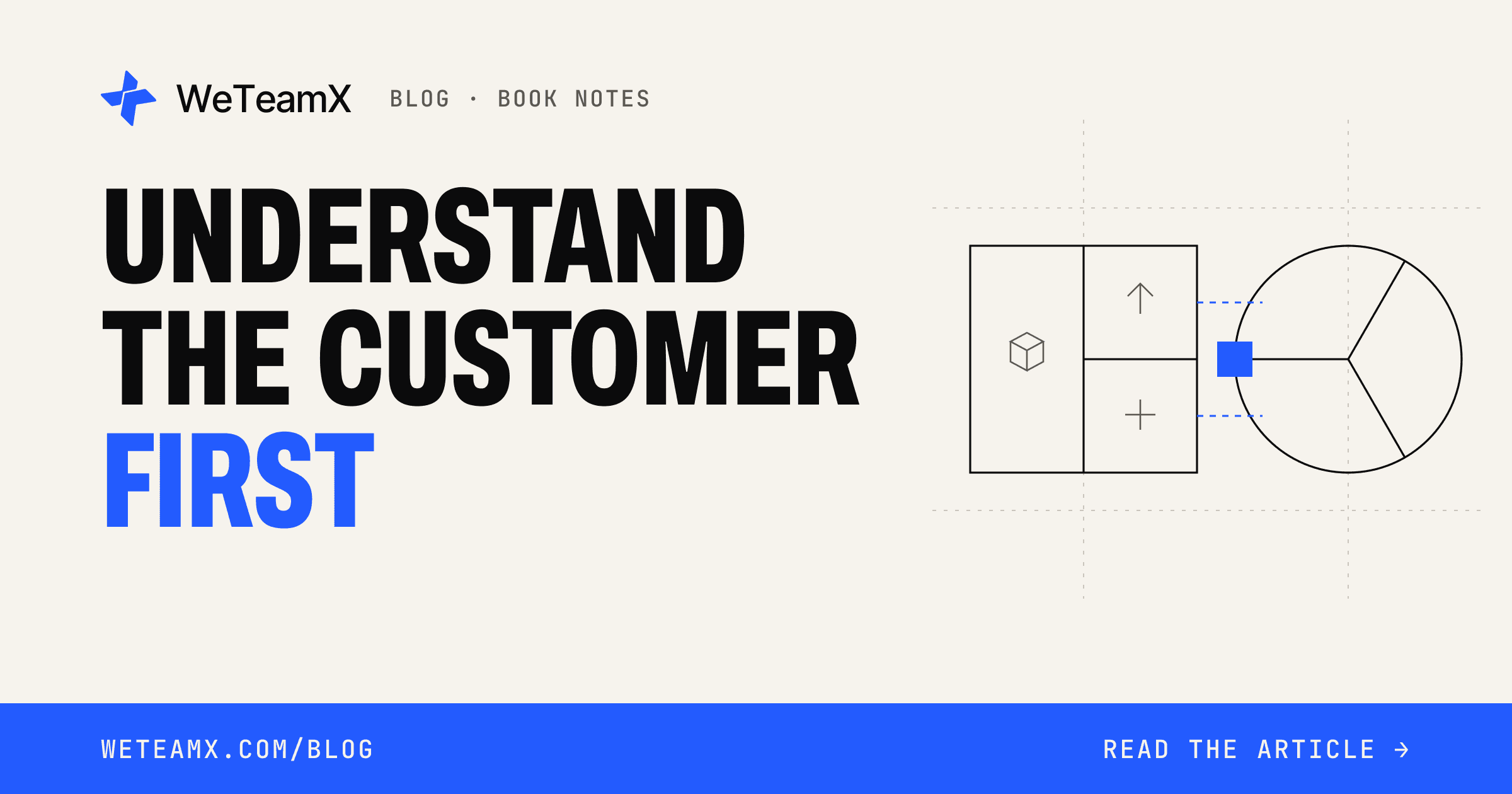
The heart of the book is a single tool: the Value Proposition Canvas. It has two sides, and the whole method is about making them match.
On the right is the customer profile, drawn as a circle. It describes one customer segment: the jobs they are trying to get done, the pains that annoy them or block them, and the gains they hope for. You do not invent this side. You observe it, and you check it.
On the left is the value map, drawn as a square. It describes what you offer: your products and services, how they relieve specific pains, and how they create specific gains. This is the side you design.
Fit is when the two sides meet: when your pain relievers answer pains the customer really has, and your gain creators deliver gains the customer really wants. The book is clear that a value proposition has no value on its own. It only creates value in relation to a specific customer. The same service can be perfect for one segment and useless for another.
One practical rule follows from this: make one canvas per customer segment. If you sell to small shops and to large companies, those are two profiles, and very likely two value maps.
The customer profile: jobs, pains and gains
Customer jobs
Jobs are what customers are trying to get done in their work or their life — the tasks they want to finish, the problems they want to solve, the needs they want to meet. The book splits them into three main kinds:
- Functional jobs — a concrete task. Get more qualified leads. Take bookings without phone calls. Send invoices on time.
- Social jobs — how the customer wants to be seen. Look like a serious, modern company to investors. Be the expert people recommend.
- Emotional jobs — how the customer wants to feel. Stop worrying about where the next client comes from. Feel in control of the numbers.
There are also supporting jobs around the purchase itself: comparing offers, choosing a supplier, learning to use what was bought, and one day leaving it. Not all jobs matter equally, so the book asks you to rank them by how important they are to the customer.
In my work, the social and emotional jobs are often the deciding ones, even if nobody says them out loud. A founder who asks for a “new website” may really need to feel confident sending the link to a big prospect. That changes what a good result looks like.
Pains
Pains are everything that annoys customers before, during or after a job — or stops them from doing it at all. The book groups them into undesired outcomes and problems, obstacles that keep the customer from starting or slow them down, and risks: what could go wrong if they try.
The most useful advice here is to make pains concrete. “Our marketing is too expensive” is not enough. Too expensive compared to what? How much does one new customer cost today, and at what cost would it start to feel fine? When you know how the customer measures a pain, you can design something that measurably relieves it. Pains should also be ranked: some are extreme, some are only mild.
Gains
Gains are the outcomes and benefits customers want. The book describes four levels, which I find very useful in sales conversations:
- Required gains — without them the solution does not work at all. A website has to load and work on a phone.
- Expected gains — basic things the customer expects even if they are not strictly needed. It should look professional.
- Desired gains — things the customer would love and will tell you if you ask. It should bring in leads while I sleep.
- Unexpected gains — things the customer would not think to ask for. This is where you can stand out.
As with pains, gains should be concrete and ranked. “More sales” is a wish. “Ten qualified enquiries a month from companies with more than 50 staff” is a gain you can design for and measure.
What the client says is not always the problem
This is the part of the book that matters most to me as a business strategist. The canvas only works if the customer profile is true. And the profile is never just a copy of what the customer says in the first meeting.
What the client says
- “We need a website.”
- “Our sales are low.”
- “We need marketing.”
What we need to learn first
- 01Where are you now?
- 02Where do you want to be?
- 03What is stopping you?
- 04What have you already tried?
- 05What does success look like — to you?
- The real problem
Each of those five questions maps onto the canvas. Where they are now and what blocks them are their pains. Where they want to be and what success looks like are their gains. What they have already tried tells you which jobs they really care about — people only spend money and time on jobs that matter to them — and which solutions already failed.
The book adds an important warning: what customers say and what they do are two different things. People are polite in interviews. They tell you what they think you want to hear, or what they wish were true. So the authors recommend looking for evidence in behaviour: what the customer has already paid for, what they stopped using, what they do on a normal day. In our discovery meetings, “what have you already tried?” is often the question that gives the most honest answer.
A typical example. A company asks for “more marketing” because sales are flat. When we look closer, enquiries are coming in — but they wait two days for a reply, and half of them go cold. The real pain is not visibility. It is speed of response. More marketing would have poured more water into a leaking bucket; a simple booking flow and an automatic first reply fix the leak. Same client, same budget, very different solution.
Only then: building the value map
Once the customer profile is clear, the left side of the canvas can be designed. The value map has three parts:
- Products and services — the list of what you offer: physical, digital, a service, or a mix.
- Pain relievers — how exactly your offer removes or reduces the pains you found, ideally the most extreme ones.
- Gain creators — how exactly your offer creates the gains the customer expects, desires or would be surprised by.
Two points from the book are worth repeating. First, a good value map does not try to address every pain and every gain. It picks the few that matter most and handles them extremely well. A long list of features is not a strategy. Second, products and services do not create value by themselves — only in relation to a specific customer profile. A beautiful website that answers none of the customer’s ranked pains is still a bad value proposition.
In practice this is where many agencies and their clients fall out of step. The agency starts from its service list and fills the value map first. The client starts from a symptom. Neither starts from the ranked jobs, pains and gains — so the project can be delivered perfectly and still not move the number that mattered.
Fit happens in three stages
The book describes fit not as one moment but as three stages, each with a different kind of evidence.
- 01
On paper
Problem–solution fit
You have evidence that customers care about these jobs, pains and gains, and you have designed a value proposition for them.
- 02
In the market
Product–market fit
You have evidence that real customers want it: they use it, pay for it and come back.
- 03
In the bank
Business model fit
You have evidence that it earns more than it costs to make and deliver, again and again.
Problem–solution fit happens on paper. You have evidence that customers care about certain jobs, pains and gains, and you have designed a value proposition that answers them. You do not yet know whether they will buy it.
Product–market fit happens in the market. You have evidence that customers actually value what you built: they use it, pay for it and come back. The book is honest that this stage is long and repetitive, and that many early ideas turn out not to create value at all. That is exactly the stage where, according to CB Insights, 43% of failed startups got stuck.
Business model fit happens in the bank. A great value proposition still fails if the business model behind it does not work — if it costs more to create and deliver the value than the customers pay. This is why the authors place the Value Proposition Canvas inside the larger Business Model Canvas: the value proposition is only one of nine building blocks.
Ten traits of a strong value proposition
The book offers a short checklist for judging a value proposition. In my own words, a strong one:
- Sits inside a business model that works and makes money.
- Focuses on the jobs, pains and gains that matter most to the customer.
- Goes after jobs that are not done well today, pains that are not solved and gains that are not delivered.
- Targets a few jobs, pains and gains — and handles them extremely well.
- Goes beyond functional jobs to emotional and social ones.
- Matches the way customers themselves measure success.
- Focuses on things many people have, or that some will pay a lot for.
- Is different from competitors on the points customers care about.
- Beats the competition clearly on at least one of those points.
- Is hard to copy.
Point six is the one I come back to most. If a client measures success in booked calls and we report page views, we have not understood their gains — no matter how good the work is. That is why our discovery sheet always asks: “In six months, what would make you say this worked? Which number?”
Test before you build
The last big part of the book is about testing. Every canvas is full of assumptions — about which pains are real, which gains matter, and whether customers will pay. The authors treat each of them as a hypothesis to test, not a fact to defend.
Their advice is simple and very practical for small businesses: start with cheap, fast tests while uncertainty is high, and spend more only as the evidence gets stronger. Interviews and sketches come first. Then tests that ask the customer to do something, not just say something: a simple landing page, a pre-sale, a clickable prototype, a small ad campaign that measures who clicks. What customers do is stronger evidence than what they say.
For our clients this usually means we do not start with the full build. We start with the smallest version that can prove or disprove the most important assumption — and we agree on the number that decides it before we begin.
How we use it at WeTeamX
Reading this book did not give us a new service to sell. It gave us an order of work.
- 01
Understand →
Jobs, pains and gains — in the client’s words, checked against what they do.
- 02
Define →
One clear problem, ranked above the rest, with a number for success.
- 03
Build.
Only now the value map: the website, campaign or system that fits.
Every first call with a new client follows a discovery sheet built on the canvas. We ask about the business and its customers, then about their jobs, their pains and the gains they hope for, then about what they have tried and what they would count as success. We rank what we hear. Only after that do we sketch a value map — and it often looks different from what the client asked for in the first five minutes.
Sometimes the answer really is a new website. Sometimes it is a pricing change, a clearer offer, a faster sales process or one automation that saves ten hours a week. The point is that we do not know before we understand, and neither does the client. That is why every consultation with us is free: the first job is to find the problem, not to sell the solution.
Key takeaways
- Start with the customer, not the service. Jobs, pains and gains come before products and features.
- Use the Value Proposition Canvas: the customer profile (circle) is observed; the value map (square) is designed to fit it.
- Make pains and gains concrete and rank them. Design for the few that matter most.
- Treat the first request as the start of the conversation. Ask where they are, where they want to be, what blocks them, what they tried and what success looks like.
- Trust what customers do over what they say. Test cheaply before you build expensively.
- Fit comes in three stages — on paper, in the market, in the bank — and a weak match with a real need is the most common reason products fail.
Questions
What is the Value Proposition Canvas?
It is a one-page tool from the book Value Proposition Design. The right side, the customer profile, lists a customer segment's jobs, pains and gains. The left side, the value map, lists your products and services, how they relieve pains and how they create gains. You have fit when the two sides match.
Who wrote Value Proposition Design?
Alexander Osterwalder, Yves Pigneur, Gregory Bernarda and Alan Smith, with design by Trish Papadakos. It was published by Wiley in 2014 as part of the Strategyzer series, after Business Model Generation.
What are customer jobs, pains and gains?
Jobs are what customers are trying to get done: functional, social and emotional tasks. Pains are the bad outcomes, obstacles and risks around those jobs. Gains are the outcomes and benefits customers want, from the required to the unexpected.
What is the difference between problem–solution fit and product–market fit?
Problem–solution fit is on paper: you have evidence customers care about certain jobs, pains and gains and you designed an answer. Product–market fit is in the market: you have evidence customers actually use and pay for what you built.
Can a small business use the Value Proposition Canvas?
Yes. It needs no software or budget — one canvas per customer segment, filled in from real conversations and checked with cheap tests. It is often most useful for small companies, because it stops them spending on a solution before the problem is clear.
Sources
- Osterwalder, A., Pigneur, Y., Bernarda, G., Smith, A. — Value Proposition Design: How to Create Products and Services Customers Want. Wiley, 2014.
- CB Insights — The top reasons startups fail (431 venture-backed shutdowns since 2023).
- Value Proposition Design
- Value Proposition Canvas
- Business strategy
- Customer research
- Product-market fit

Written by
Alireza Khalili
Co-founder & Business Strategist at WeTeamX
Runs the business side. He reads the market, shapes the strategy, and makes sure every plan is tied to a number that matters.
Follow Alireza on LinkedIn ↗